



Many children today grow up with mobile phones. Social media is where they learn, play, and make friends, but it also harbors many risks that they lack the experience to handle on their own. In this article, Anti-Fraud reviews the real dangers and suggests ways for parents to support their children safely and effectively.
1. I'm living a part of my life online.
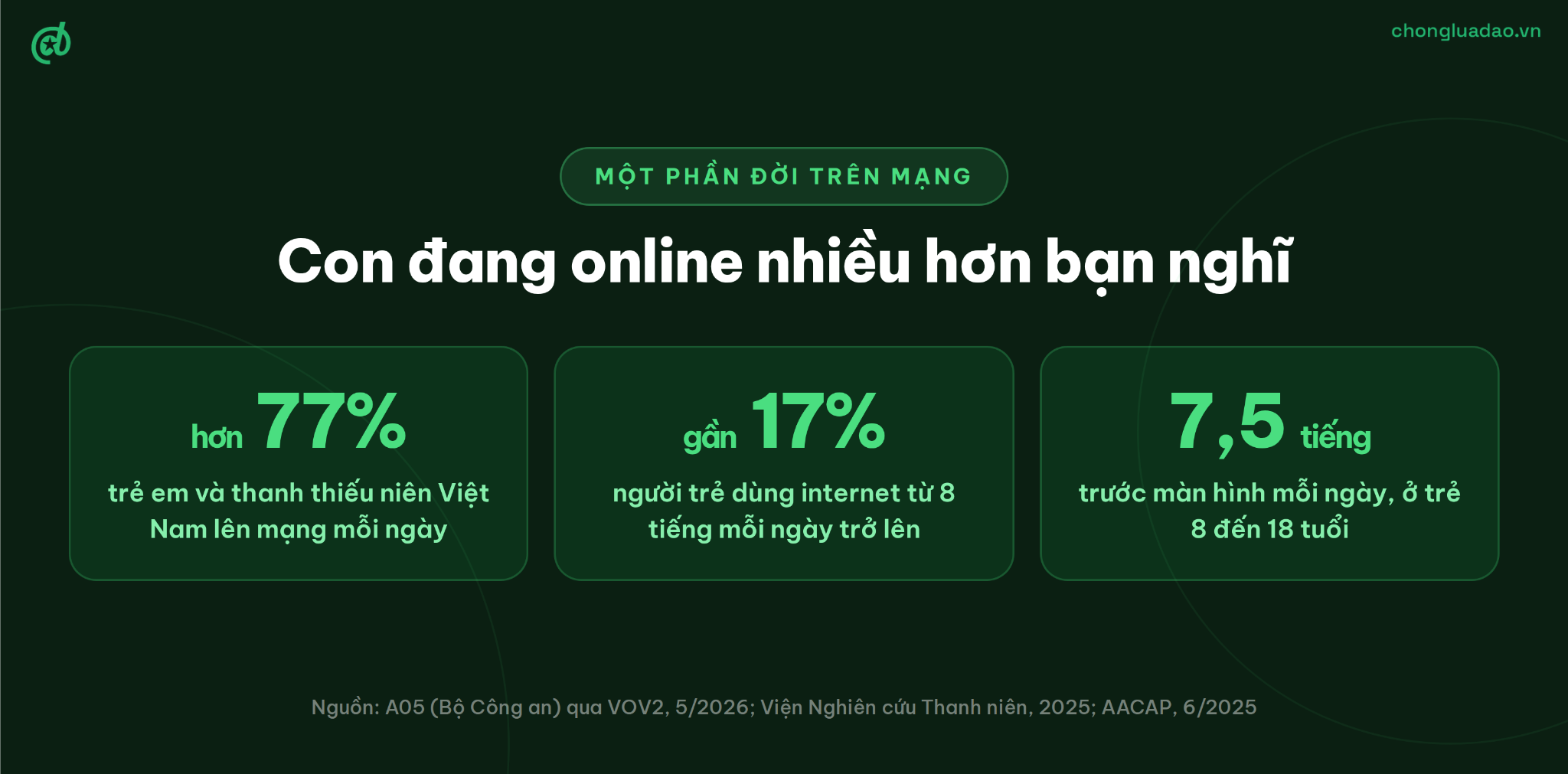
For many children today, the internet is almost a "second world." According to data from the Cyber Security and High-Tech Crime Prevention Department (A05, Ministry of Public Security), as reported on VOV2 (May 2026), more than 771 Vietnamese children and teenagers access the internet every day. This number is also consistent with the Disrupting Harm report in Vietnam, which recorded that 891 children aged 12 to 17 had used the internet in the last three months, and as many as 871 of them go online daily.
The amount of time young people spend staring at screens is much greater than many people mistakenly believe. According to the 2025 Youth Survey Report by the Institute for Youth Research (Central Committee of the Youth Union), nearly 171% of young people use the internet and social media for 8 hours or more per day. Internationally, the American Academy of Child and Adolescent Psychiatry (AACAP, updated June 2025) reports that children aged 8 to 18 spend an average of 7.5 hours per day on screens.
The reason children find it hard to look away is because the platforms are cleverly designed to keep users engaged. Data from DataReportal (cited via Rentracks Vietnam, August 2025) indicates that an active user spends an average of 34 hours per month on the TikTok app alone. Notably, age boundaries are being broken: a survey by Thorn (2025) in the report. Youth Perspectives on Online Safety The study revealed that nearly half of the children surveyed had joined a social media platform before the platform's minimum age requirement.
2. Extremely dangerous potential risks
The biggest threats often come from the people and content hidden behind the screen, not from the device itself.
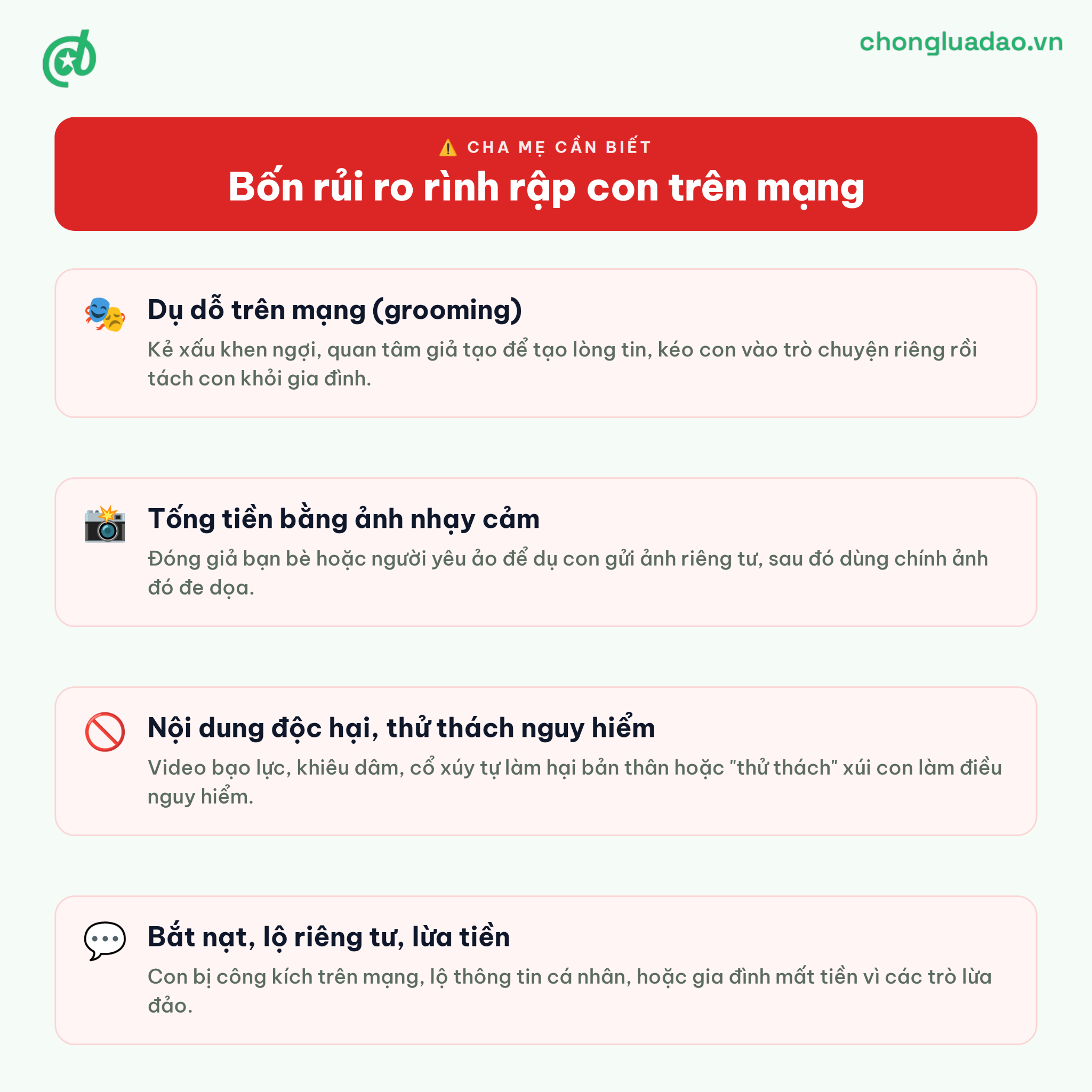
The first risk group is online grooming. This is a process where perpetrators use false praise and attention to build trust, draw conversations into private spaces, and try to separate children from their families. According to the National Center for Missing and Exploited Children (NCMEC) in the United States, the number of reported online child grooming incidents skyrocketed to 1.4 million cases in 2025 (an increase of 1561 cases compared to the previous year). Meanwhile, in Vietnam, the Cyber Security and High-Tech Crime Prevention Department of the Ministry of Public Security (as reported by VOV2, May 2026) also recorded that authorities handled dozens of cases of online fraud, grooming, psychological manipulation, and kidnapping in the first half of 2025 alone.
The second risk group is sextortion, where perpetrators impersonate virtual friends or lovers to trick children into sending private photos, then use those images to threaten them. According to a Thorn survey (June 2025), one in five teenagers aged 13 to 20 have experienced this situation, with one in eight victims being threatened with AI-generated deepfake photos. Simultaneously, a Our Rescue report (March 2026) also indicates a surge in AI-induced exploitation cases, increasing from 6,835 to 440,419 in just one year. (Parents need to understand that most victims are manipulated into sending the photos themselves; it's not the child's fault.).
The third risk group is harmful content and dangerous challenges, where children can easily stumble upon violent videos, pornography, videos promoting self-harm, or "challenges" that encourage dangerous actions to gain interaction.
Finally, the fourth risk group includes online bullying, privacy violations, and scams targeting family finances, which are listed in Meta's 2025 Child Safety and Harm Reduction Report. In Vietnam, statistics from the Ministry of Public Security indicate that between 2021 and 2025, the country handled over 10,000 cases of child abuse, with nearly 201 cases directly related to cyberspace.

3. How can we accompany our children safely?
Legally, Vietnam has issued Decree 147/2024 (effective from December 25, 2024), stipulating that children under 16 registering for social media must do so through the verification of their parents or guardians, and parents are responsible for monitoring the time and content their children use. This trend of stricter management is also occurring globally, for example, Australia has implemented a law prohibiting children under 16 from creating social media accounts from December 2025.
However, laws and technological tools only serve as an outer layer of defense. The strongest foundation for protecting children remains the trusting relationship with their family: according to a survey by the Family Center for Online Safety (cited above). The Washington Informer, August 2025This study shows that nearly 9 out of 10 children feel comfortable confiding in their parents when they experience anxiety online.
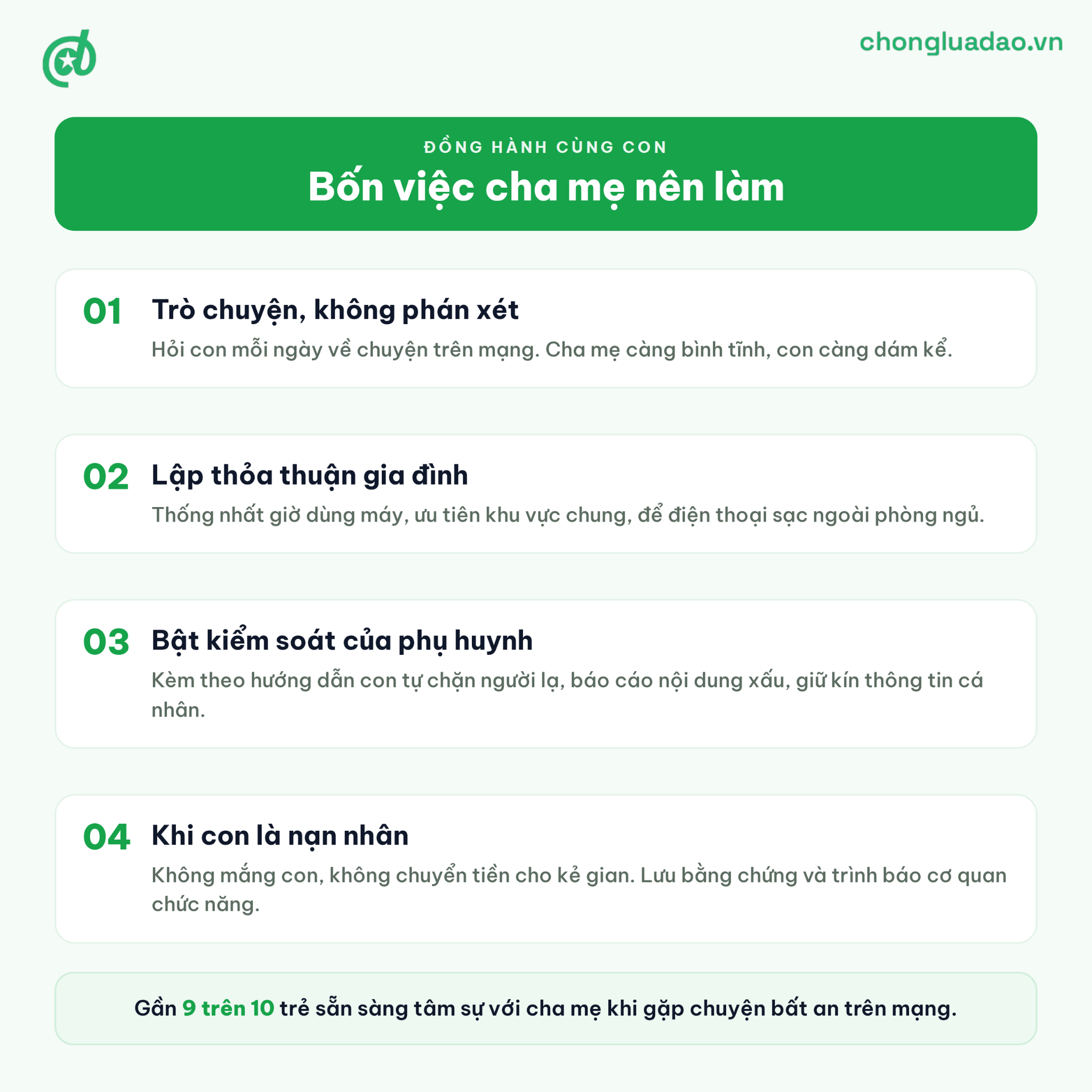
– Have open and non-judgmental conversations: Parents should proactively ask their children daily about interesting and unusual things they see online, in a calm and natural manner. When a child encounters trouble, the parents' composure will determine whether the child dares to speak up or not.
– Establish a family agreement with your child: Be clear with your child about the time and place where they can use devices. Prioritize using the device in common areas like the living room and take it away to charge in the kitchen overnight to protect their sleep.
– Use the accompanying assistive technology and instructions: Parents can enable parental controls to block adult content or limit screen time. They should also teach their children how to block unfamiliar accounts, report inappropriate content, and absolutely not share personal information.
– Know how to handle a crisis when your child is the victim: If your child unfortunately falls victim to blackmail or is threatened with sensitive photos/videos, the worst thing you can do is scold or punish them. Parents should absolutely not transfer money as requested by the scammers. Save all evidence and report it to the authorities immediately, while also making it clear to your child that they are the victim and completely innocent.




 English
  Vietnamese