



August brings the joy of children passing their exams, but it's also a busy time for families dealing with countless procedures. Taking advantage of the anxiety, busyness, and easily flustered state of parents and new students alike, scammers are back in action. Below, Anti-Scam highlights the most sophisticated scams this year, exposes the reasons for falling into these traps, and provides a practical guide to help you protect your wallet in any situation.
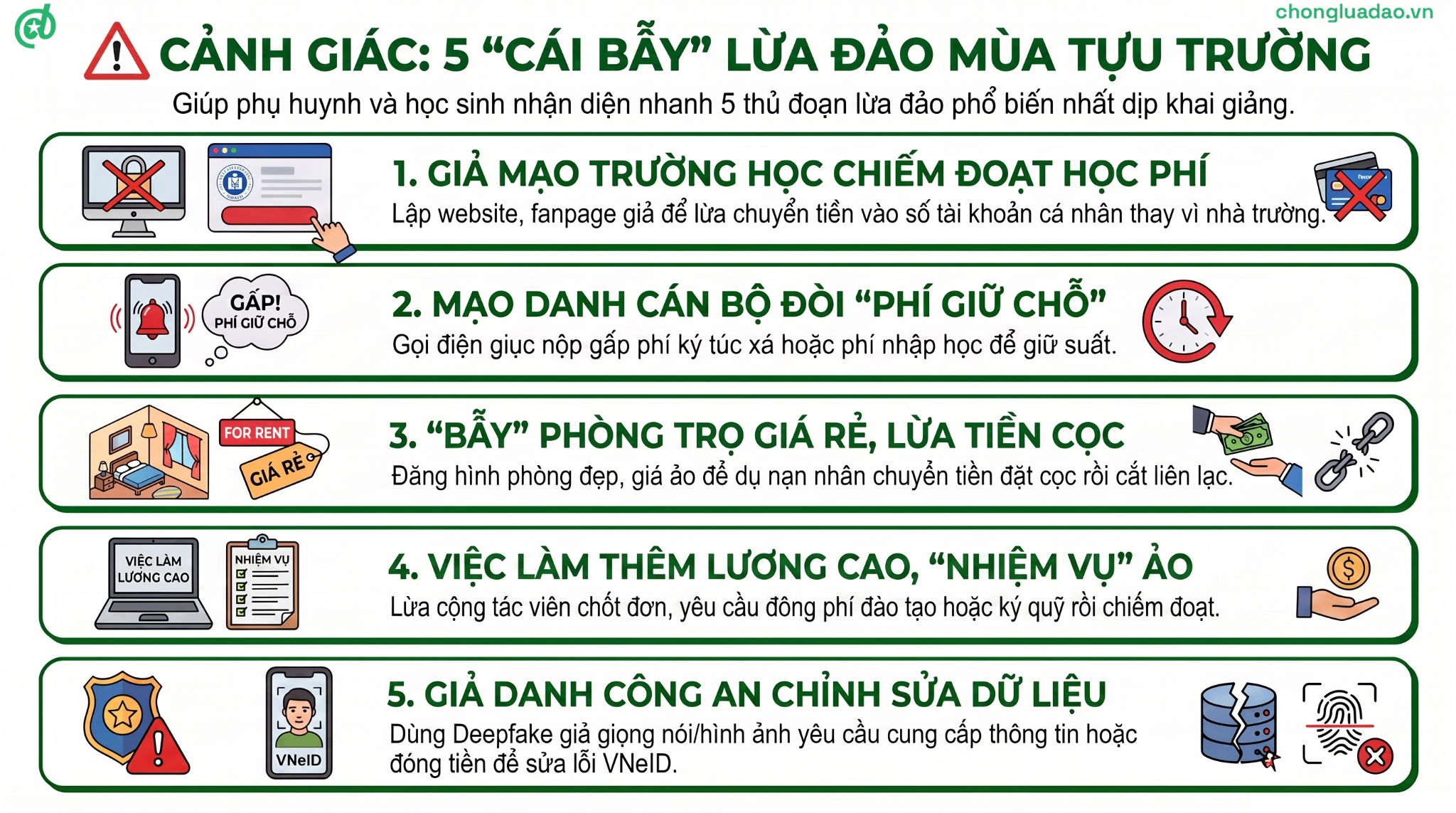
1. Five sophisticated traps set for the back-to-school season.
Constantly evolving, scammers often focus on the following familiar scenarios:
- Impersonating a school to defraud students of tuition fees: They create websites, fan pages, or emails with interfaces, logos, and enrollment information identical to the originals, then secretly change the bank account number or QR code for receiving payments, leading parents to mistakenly pay tuition fees for their children without realizing it.
- Impersonating admissions and dormitory staff: Scammers call victims posing as school officials or administrators, urging them to disclose personal information or immediately deposit a "reservation fee" into a personal account.
- Deceptive tactics for offering cheap rental rooms: They post glamorous photos of rooms with surprisingly low prices on social media to scam people out of deposits, then block all communication.
- Easy, high-paying part-time jobs: They target students who want to earn extra income through sales commissions and data entry. Initially, they pay commissions promptly a few times to build trust, then set a trap to get them to transfer money for "tasks," training fees, or deposits before absconding with the money.
- Impersonating police officers to urge people to get ID cards or VNeID: Scammers call parents, informing them that their child's ID card has a "data error," urging them to reapply for a new ID card or activate VNeID immediately. They recite the full names, school names, and identification numbers of the entire family, even using Deepfake technology to create images and voices during video calls to build absolute trust before extorting money.
So why do so many people fall for this trap? Scammers always put you in a position where you "must transfer immediately or you'll miss out." The fact that they correctly state your name, age, and school doesn't necessarily mean they're real; it mostly stems from data leaks. Don't confuse leaked data with the credibility of official agencies.
2. Change your defensive mindset: Observe the process instead of guessing what's real and what's fake.
Today's counterfeit technology is so sophisticated that it's difficult to distinguish them with the naked eye. Constantly trying to guess "real or fake" will only confuse you, so shift your focus to behavior and procedures. Standard procedures never allow for arbitrariness. A legitimate school will never request tuition payments into a personal account, will never urge you to transfer money within minutes, and will never ask for your OTP code. If you see even one of these signs, consider it a trap.
Furthermore, multi-channel communication doesn't necessarily mean it's genuine. A scam scenario can be orchestrated by switching between text messages, emails, chatbots, video calls, and even through Zalo or Telegram to build cross-trust. When receiving overwhelming amounts of information from multiple sources, call the school's official hotline yourself to verify. Remember that your phone is the most important thing to protect, as it stores your identity, e-wallet, and bank accounts. When images and voice recordings are no longer reliable, the golden rule is to proactively verify your identity using an independent channel of your choosing.
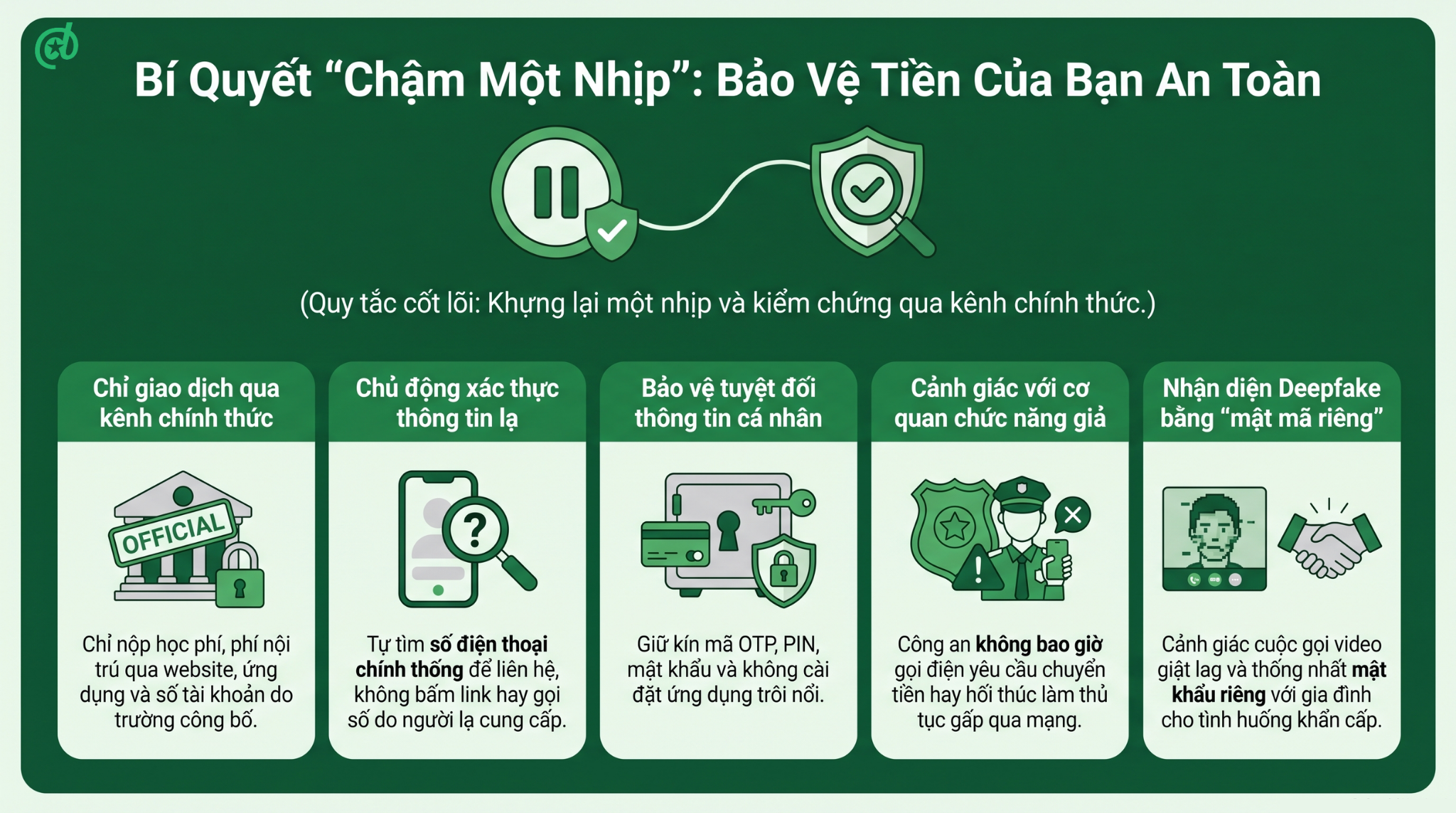
3. "Take it slow": The secret to keeping your money safe.
The core rule before any money transfer request is to pause and verify through an official channel. To protect your assets, you need to remember the following important principles:
- Only through official channels: All procedures for checking results, confirming enrollment, paying tuition fees, or registering for dormitories must be done only through the website, application, and account number officially announced by the school.
- Proactively verify information when you encounter it that seems unfamiliar: Find the school's phone number on the official website to contact them; absolutely do not click on links or call phone numbers provided by strangers.
- Absolute protection of personal information: Keep your OTP, PIN, and password confidential; do not scan unfamiliar QR codes or install apps from unknown sources.
- Be cautious about renting accommodation and taking on part-time jobs: Always inspect the property in person, meet the landlord directly, and carefully read the contract. Reputable recruitment agencies never require collaborators to pay fees or deposit money in advance to get a job.
- Be vigilant against fake official agencies: The police will never call you online requesting money transfers or urging you to expedite procedures. If you encounter such a situation, hang up and go directly to the nearest police station to report it.
- Identifying Deepfakes: Be wary of video calls if you notice choppy images or lip movements that don't match the voice. Families should agree on a unique password beforehand to identify loved ones in emergency situations.
What to do if you fall into the trap? You need to immediately call the bank's hotline to request that the transaction be blocked and reviewed. Take screenshots of the entire message history, account number, the scammer's phone number, and transaction images as evidence. Then, go to the nearest police station to file a report and receive instructions on how to proceed. Immediately change the passwords for any personal accounts, social media accounts, and bank accounts if you have already provided information.




 English
  Vietnamese